
To Kill a Tyrant
the world outside your window

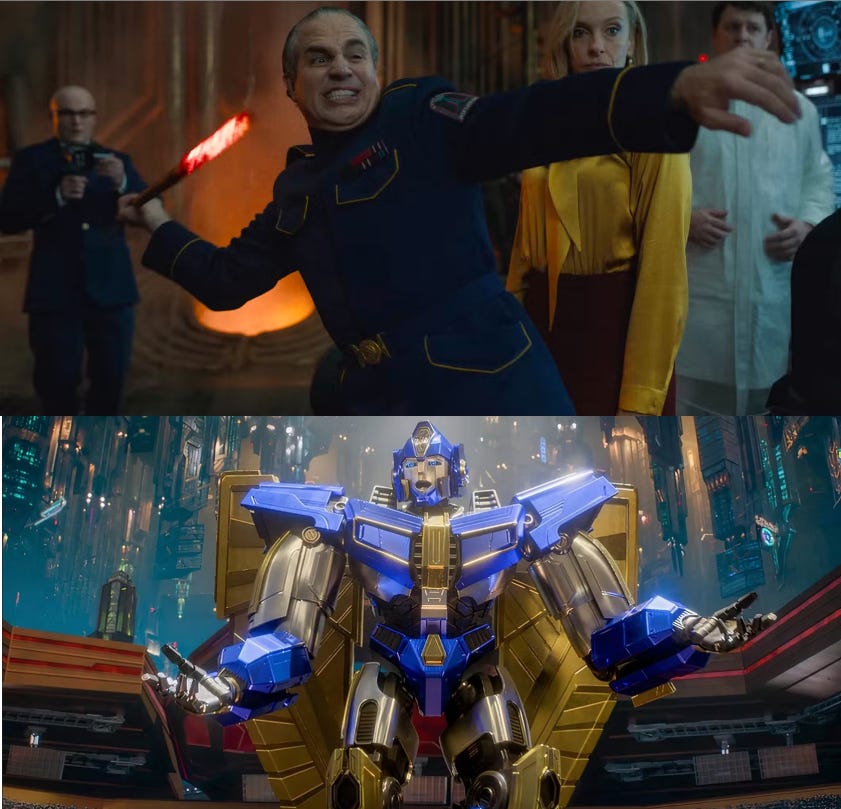
Images via ScreenRant
In the 1939 film The Wizard of Oz, the wizard who rules the magical land of Oz turns out to be a carnival performer from the United States who has insinuated himself into this role. He is a fraud. Unlike other characters in this world, he does no real magic. The film doesn't play his deception for horror. Instead, it passes it off as a forgivable, even amusing, character flaw, one that doesn't stop him from being lovable. This man forced the other characters to assassinate a rival for him, and yet the film is so tolerant of him that the actor playing him makes him come off as just a pleasant grandfatherly figure in his final scenes.
This post is entirely about endings, so, spoiler alert.
Films made now know that putting carnival barkers in the highest positions of power is a recipe for disaster. Two recent sci-fi would-be blockbusters, Bong Joon-Ho's Mickey 17 and Josh Cooley's Transformers One, tackle that fact from different angles. Both of these movies were critical darlings but didn't quite connect with the general public, and there are a lot of reasons you could cite for that but one of them, I think, is that they're not escapist enough. They're about our current moment, aggressively so, even. Both of these films are about the destruction wreaked by a lying, boastful leader who acts like a showman and likes to be filmed. He prances, he preens, he grins, and he flexes. He's an entertainer, and his ability to entertain is his weapon. He is crude and crass. He is aggressive, absurdly so, but also very bad at looking out for his people's interests. He has no respect for anyone outside of his own social circle, and little respect for people within it.
Mickey 17 is a hard-R movie. Transformers One is a PG-rated family film. Mickey 17 has explicit sex scenes and scenes where people are gruesomely injured on camera. Transformers One is a completely romance-free film with a lot of combat, but the characters are robots so it has a loophole to exploit.
In Mickey 17, our hero, a cloned slave for a cult-run space colony, kills Kenneth Marshall (the tyrant) in a suicide bombing. This stops Marshall from massacring the pillbug-like beings indigenous to the planet. Our other hero, another clone, survives, so the movie gets to have its cake and eat it too. Marshall had earlier forced both of the clones to wear vests with explosives in them, to force them to obey his orders, and that didn't turn out well for Marshall. One Letterboxd user called this film "the most money anybody has ever spent to say that they think someone should kill Trump." Another user’s entire review of this movie was "More movies should tell us to kill Donald Trump."
In Transformers One, our hero, a lower-class miner from an alien planet, stops his friend and erstwhile ally, a fellow miner, from killing Sentinel Prime (the tyrant). The hero and his friend fight each other furiously, and their friendship ends. Some bloggers really hated this ending. A blogger said "I don't think it's that important what happens to Sentinel personally. Certainly not as important as the movie wants us to think it is." A Tumblr user wrote "when Megatron tries to kill the one (1) evil dictator who’s just fucking branded him, who’s still lying to his face while his people continue to die to the guy’s fuckin’ honor guard, Optimus Prime is like, HELLO, HUMAN RESOURCES?" This wasn't the only aspect of the film these bloggers took issue with (for some reason they really, really hate the fact that Optimus gets appointed as ruler of Cybertron by the Transformers' deity in this film; I think that part was pretty cool).
These movies came out of different parts of the American film industry. The influences and incentives on them are different. They were made at different studios. They were released only six months apart, but Transformers One was in some kind of development since 2015, whereas Mickey 17 is based on a 2022 novel. Mickey 17 is the work of an auteur with a focus on class issues, animal rights, and anti-capitalism while Transformers One is very strictly an adaptation of a 40-year-old toy franchise's 2010s-era series bible. (The Transformers shows of the 2020s don't even use that bible, so the film is a bit of a throwback.) Mickey 17 was its director's follow-up to a movie that won an Academy Award for Best Picture. Transformers One is an attempt to get some life out of a long-running series of popcorn films. These are totally different projects, and I think I am the first person to juxtapose them (they didn't even come out in the same year). But I am putting the films in conversation with each other, because they both end up asking the question "what do you do with a tyrant? (one a lot like the current American tyrant)" and unsurprisingly the children's film has more merciful impulses than the adults' film.
I like both of these films. I don't personally wish to pit them against each other, but the question kind of writes itself. These films believe in different values.
I guess, if you want your kids to do political assassinations when they grow up, don't show them Transformers One. :) I hope your kids can handle the melancholy Millennial mood of Mickey 17.
In all seriousness, though, people writing films these days probably should wrestle with how to allegorize the current moment. Should they avoid it entirely? (That seems to be commercially wise.) Should they do it gently, lightly? Should they tackle it head-on? Should they embrace pro-Trump themes? (I imagine there is a current temptation to do that; surely it seems like there's untapped money there.)
We will probably not see Mickey 17's like again for a long time. Enjoy it. Appreciate it. Its simultaneously silly and bleak tone suits its aims very well, and it mostly benefits from its bluntness. I personally wish Mark Ruffalo's performance in it didn't channel Trump so blatantly, but I do like the intensity of theme and character the film gets out of everything else it does. It's a deeply moving melodrama. Also, no one is going to misinterpret it the way some people misinterpret Paul Verhoeven's sci-fi films. It's funny, certainly funnier than Transformers One. (The worst thing about One is its attempts at comic relief. I've never understood the point of comic relief; the drama of a story is the fun of it, so why would we need to be relieved from it? But the comedy in Mickey 17 isn't relief so much as an integral part of the absurd texture of the story. It doesn't feel alien there.)
Transformers One is pretty good. It had the great misfortune to compete directly with The Wild Robot, and it probably should have been made a decade earlier, when "Transformers movie" was still a thing some theatregoers wanted. It's a planetary romance where the hero is a native, not an Earther who got rocketed in. It has all the virtues critics say it has, although as someone who hasn't seen any of the Michael Bay films I feel like One shouldn't get a gold medal just for having developed characters (Matt Zoller Seitz: "fascinating to see this material treated with something approximating sensitivity and warmth"). It has other virtues too (it's pretty to look at, it stages action scenes well) that I think have been a bit under-praised. If you really want to share a recent spacefaring adventure film with younger viewers or viewers who are squeamish about edgy stuff, One is a good fit.
I've been meaning to watch Micky 17, this now has reignited that desire, thanks!