
Conclave review
Vatican drama

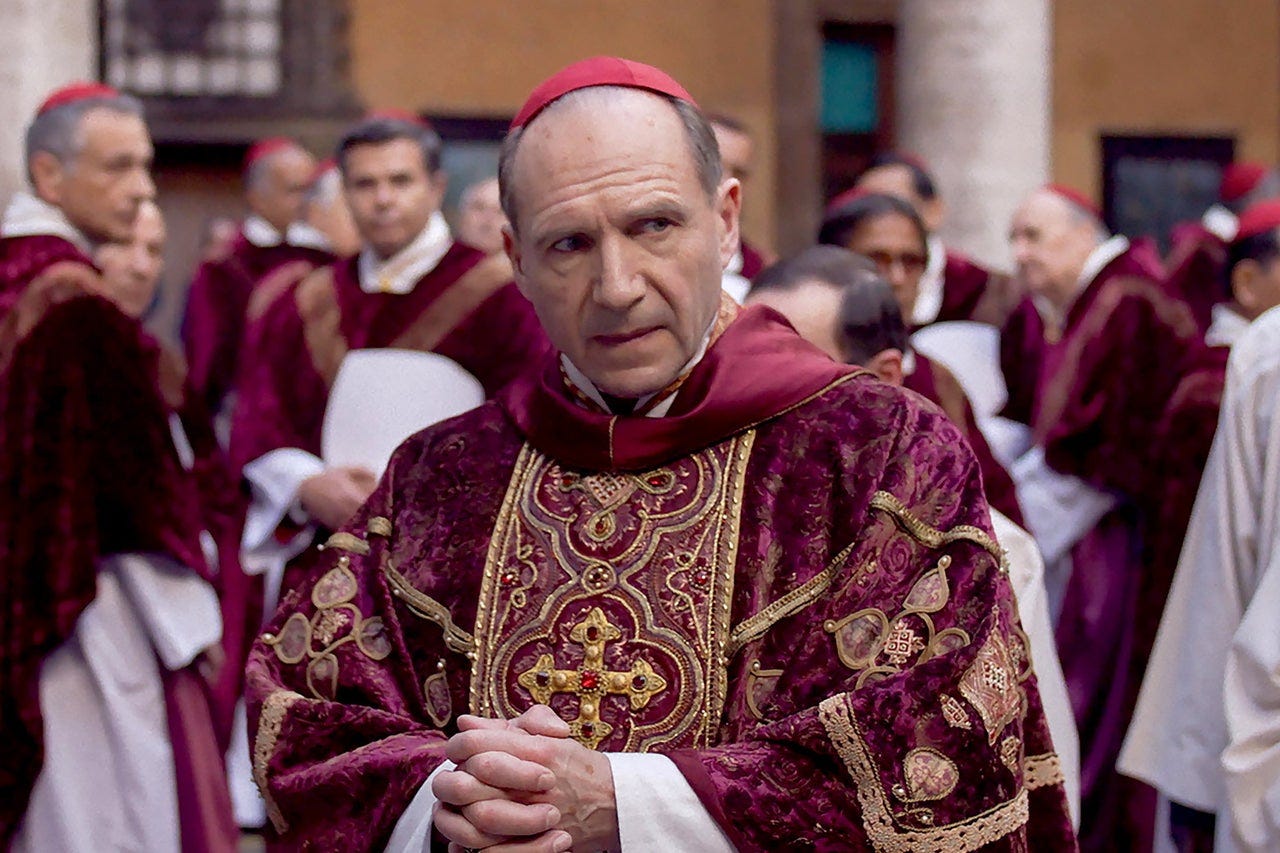
Ralph Fiennes in Conclave. Image via Slate.
Merry Christmas, everyone!
Conclave (2024) is a drama about a fictional papal election. The first time I saw it, I was underwhelmed by it (although I didn’t think it was actively bad) because I was analyzing it as a treatise on the intra-Catholic debates it depicts, and its treatment of those debates is kind of superficial. But some months later I revisited it, and found that it’s a very moving story about the psychology of an old, depressed man regaining hope. Spoilers will abound.
Cardinal Thomas Lawrence, the protagonist of this film, is a weary, beaten-down man. His relationship with God is suffering, as he finds it hard to pray. He has lived through every fight and every scandal in recent Church memory, and he is exhausted. He wants to leave the clerical life altogether, but he has no choice but to oversee the conclave. There are a lot of slow-paced, pensive shots of the camera just looking around at goings-on in the Vatican, shots that focus on buildings and masses of people moving or sitting around. On first viewing I found these shots quite boring but on second viewing I realized that they are meant to put us into Lawrence’s mental state, to make us feel his weariness with this institution’s rhythms. The uneasy music that plays lightly in these shots is a clue.
Over the course of the film, the cardinals vote, and re-vote, with no candidate getting enough votes to win until the end. Between votes they socialize and discover evidence of scandalizing, disqualifying wrongdoing in each others’ pasts. A lot of the fun of the film comes from the detective story-like quality of the middle portion of it, in which Lawrence quietly investigates evidence of corruption (bribery, sexual misconduct) among the cardinals. Having said that, Conclave is a drama, not a thriller. A lot of reviewers have inaccurately described it as a thriller, purely because it has a few plot twists, but it’s not paced or structured like a thriller. There are virtually no scenes that try to generate tension. The movie’s pace is deliberate and reflective, not propulsive.
Conclave highlights conflicts between liberal and traditionalist Catholics. (Cardinal Bellini explicitly uses the word “liberal” to describe himself and his allies.) There are two axes to this. There’s a conflict over ethnic chauvinism, with Cardinal Tedesco arguing that European Catholics are superior to all other people, and there’s a conflict over what some Catholics call “pelvic issues.” The film has too few scenes of characters discussing or debating these things to fully explore the nuances of them. Cardinal Bellini announces that he supports liberal positions on the role of women in the church, interfaith dialogue, and pelvic issues, but he never has to defend these positions or even explain them. The line where Bellini signals his support for access to contraception is worded in a snobbish and condescending way (he calls large families “families of ten children because Mama and Papa know no better”), suggesting that he is more of a partisan warrior than a humane shepherd.1 On two occasions Cardinal Tedesco delivers long, hostile rants about things and people he doesn’t like (Vatican II, Muslims, non-Italian popes, the possibility of African popes, interfaith dialogue, etc.) and the characters he’s talking to who aren’t radical traditionalists just respond with a couple of words or walk away from him. Cardinal Lawrence does manage to get a few words in about the universal nature of the Church meaning no ethnic group should be prioritized, but this is quite brief. Lawrence’s earlier speech about the danger of “certainty” is allowed to go on for a long time, but the rest of the film doesn’t really back it up. What this film dislikes isn’t certainty so much as exclusivity, the desire for spaces that are only for some kinds of people.
Really, though, when it comes to assessing a leader, this film cares more about character than policy. On policy Lawrence seems to favour Bellini (he blatantly collaborates with Bellini’s efforts to campaign against Tedesco) but he is also very friendly to Cardinal Adeyemi. Adeyemi is said to be “more reactionary than Tedesco” not on ethnic chauvinism, but on pelvic issues. Adeyemi wants the Catholic Church to argue for secular law to ban homosexuality and to declare that all gay people are inevitably damned. Lawrence, and the film itself, seem to think Adeyemi is preferable to Tedesco, and some of that, I think, simply comes down to the fact that Adeyemi is always polite and respectful when talking to the other characters whereas Tedesco is excessively confrontational and willing to insult people to their faces. Even when confronting Adeyemi over an affair with a nun, Lawrence is still very nice to him.2
All the infighting that goes on over the course of the film does nothing to improve Lawrence’s mental state. The scandals multiple cardinals go through in the film further reinforce his conviction that the church hierarchy is irredeemably corrupt. An Islamist group sets off some bombs in Rome, with one hitting the very building the conclave is taking place in. But something happens that restores Lawrence’s sense that good things can still happen in this world.
That something is the rise of Cardinal Benitez. Benitez is a humble, saintly missionary who was secretly made cardinal of Kabul by the late pope. He gently rebukes Tedesco when Tedesco uses the bombing as an excuse to declare a modern crusade. He actually wins the conclave, being the only major candidate still standing without a scandal. Benitez lacks Bellini’s condescension, Tedesco’s racism, Adeyemi’s sexual sins, and Tremblay’s financial corruption. He takes the papal name “Innocent.” The possibility of an innocent man being pope is a great cleansing and healing for Lawrence. It’s a wonderfully uplifting ending, and it’s much appreciated in a world where every leader seems to be a fount of corruption.
Benitez is intersex. (For those of you who don’t know, this means he was born with both male and female sex organs). He reveals this to Lawrence in a conversation after winning the conclave, because Lawrence has evidence of it and demands an explanation. Benitez says that after he discovered, many years into ministry, that he had a uterus, he considered a hysterectomy but decided that “it seemed to me more of a sin to correct His handiwork than to leave my body as it was.” I’ve seen conservatives in Internet comments sections refer to Conclave as “the movie with the transgender pope.” These commenters clearly don’t know about the existence of intersex people, but they also don’t seem to realize that this line, denouncing gender reassignment surgery, affirms their anti-trans convictions.
Conclave reminds us that sometimes, people who hate every marginalized group don’t win elections. That is a message worth hearing. It’s not ideal if you want to use it as a primer on contemporary intra-Catholic debate. The best thing about the movie is simply the character of Cardinal Lawrence, and his journey from weariness to renewal. I felt for him profoundly the second time I saw this film. All of us in this age are a bit like him.
Post-script:
A friend of the blog has pointed out some issues with the film that should be noted, and the fact that my review didn’t touch on them is unfortunate.
The use of words like “liberal” in the film suggest that the film is prioritizing applicability as a metaphor for secular politics over accurate depiction of how Catholic cardinals would talk to each other. Catholic leaders are (in ways that I, a Protestant, don’t really understand) committed to the idea that the Church’s teachings don’t change. They do have disputes over how to interpret/apply the teachings, but to literally say that they are changing the teachings would conflict with how the Church works, so the use of a word like “liberal” (which implies changing things) would not be used. Catholics care about orthodoxy (a concept that does not get discussed in the film) and the absence of any reference to orthodoxy in some of the debates the characters have is not realistic. Using the Church as a metaphor for something else, (I’m not 100% sure this is what the film was trying to do, but I can see evidence for it) is arguably unfair, since the Church is an important topic and body of people and worthy of serious discussion in its own right. If you have concerns that this film is essentially exploiting the Church to make points about something else, it’s totally fair to object to that.
In the paragraph where I talk about Benitez being intersex, I tried to correct some misconceptions I have seen people have about the film, but I didn’t cover every nuance of the issue. I recommend reading this Catholic News Agency article which goes into why the Catholic Church in the real world would have objections to Benitez being a priest. I don’t agree with some of the ideas expressed in the article, but this is literally not an issue I have a say in, (again, I am not even Catholic).3
For me, these issues don’t ruin the film, but you might feel differently. Discretion is advised.
The Salty Cinema blog once said “Bellini speaks like someone transplanted the brain of a Hollywood studio exec embroiled in a diversity scandal into the body of a Catholic priest,” which may be the funniest thing I have ever seen on Substack.
The film’s oddly sympathetic treatment of Adeyemi could have benefited from some reference to the possibility that African clergy are so hostile to homosexuality because they expect that LGBT-affirming church stances would be used by Islamists to justify anti-Christian pogroms. There’s a scene in the novel the film is based on where Tedesco and Adeyemi bury their earlier animosity and try to form a “traditionalist alliance.” It would have been useful to keep this scene, partly because it would humanize Tedesco a bit but mainly because it reflects the reality that conservative Christians in the Western world love making use of statements by African cardinals and bishops in their rhetoric.
As far as I am concerned, Benitez is a man. However, I have been informed that under the Catholic Church’s definition, an intersex person who has both male genitals and a uterus must be considered a woman, and that therefore the real issue with Benitez’ eligibility for the papacy, and the priesthood in general, is the ordination of women. I’m an Anglican; we ordain women. But Catholics don’t!
In all fairness, I haven't seen Conclave, so I am going by what you (and others) have written. It sounds like the typical exploitation of Catholicism for drama that's woefully inaccurate. My comment is not against you, but against the film. First off, there is no such thing as "liberal" Catholics when it comes to the faith itself and the teachings of the Church. That's a modern political term. It's either "orthodox" (for Church teaching) or "heterodox" (against Church teaching). The Church's doctrine doesn't change. It seems to me that all of the characters you mention are heterodox.
Cardinal Tedesco's rant against the "possibility" of African popes is just one example that the writer of the book and/or this movie didn't do enough research. Did you know that there were African popes? https://www.bbc.com/news/articles/c787y082l47o
As for the "intersex" twist at the end, Cardinal Bellini should have stepped down upon learning about her condition because she is not validly ordained. Please read this article about the issue:
https://www.catholicnewsagency.com/news/260039/seminary-rector-responds-to-conclave-movie-why-only-men-can-be-priests
I think this part of the article is particularly important:
The Catholic view of this phenomenon, as explained by Father Tad Pacholczyk of the National Catholic Bioethics Center, is that intersex people do not possess a "third sex" but rather exhibit variations within the male or female sex. While advocating for compassionate care for intersex individuals, Pacholczyk acknowledged that these individuals might face unique challenges in supporting their "intrinsic maleness" or “intrinsic femaleness.”
Any treatment that an intersex person undergoes should aim to restore bodily functions that align with a person’s underlying biological sex rather than affirming a different gender identity, Pacholczyk said.
Now I’d like to see the film!